

Housing Health Risks – Healing Windows
The forthcoming second stage of Awaab’s Law adds hazards in social housing that must be made safe within 24-hours of notification. The importance of windows and doors in tackling housing health risks is well known.
The strict additional rules will come into force on 30 November 2026.
Introduced through the Social Housing (Regulation) Act 2023, Awaab’s Law places a legal duty on landlords to act swiftly on health hazards, particularly damp and mould.
Phase 1 of Awaab's law
Since 27 October 2025, social landlords had to investigate and make safe all emergency hazards and any significant damp and mould hazards.
An emergency hazard is one which poses an imminent and significant risk of harm to the health or safety of an occupier. A risk of harm is considered imminent and significant when a reasonable landlord would take steps to make it safe within 24 hours.
Government guidance states that emergency hazards might include serious damp and mould, gas leaks, broken boilers, electrical hazards, loss of water supply or water leaks and especially broken external doors or windows where there is a risk to home security.
Significant damp and mould hazards must be investigated within 10 working days and made safe within 5 working days. Everything else is on a 24-hour deadline.
Significant damp and mould hazards
A significant hazard is one which poses a significant risk of harm to the health or safety of an occupier. There is a significant risk of harm when a reasonable landlord would take steps to make the hazard safe as a matter of urgency, but not within 24 hours.
Only significant hazards caused by damp and mould are covered by Phase 1 of Awaab's law. Awaab's law will be extended to cover more significant hazards in social housing from November 2026 and again in 2027.
It should be noted that a landlord has to consider the vulnerability of each tenant as a significant risk could be upgraded to an emergency hazard in for example, a case where a child has a respiratory weakness.
Awaab Ishak
2-year-old Awaab Ishak, died in 2020 from a lung condition caused by mould in his home. Awaab’s parents told their social landlord about the mould many times over 3 years, yet nothing was done to fix the problem.
Shelforce White Paper
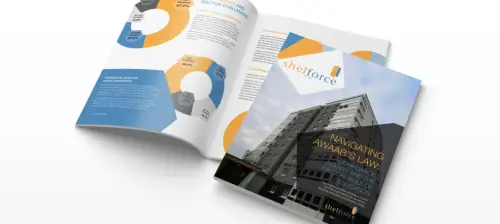
Installation Eye previously reported on the launch of Shelforce's Awaab's Law white paper and its findings on the role of windows, doors and ventilation in improving housing safety.
Based on a UK-wide survey of private landlords, housing associations and local authority housing providers, the paper examines current levels of understanding around damp and mould and highlights where meaningful progress still needs to be made.
It also presents a clear opportunity for the fenestration sector to play a more strategic role in supporting social landlords as they respond to evolving legislation and rising expectations around tenant safety.
Phase 2, November 2026
The second stage, from November 2026, will extend the regulations to cover additional significant hazards in social housing such as excess cold and excess heat.
Also included will be fire and electrical hazards; domestic and personal hygiene; food safety; the risk of falls associated with baths; and the risk of falls on stairs, between levels or on level surfaces.
Phase 3, October 2027
The final stage, from October 2027, will mean social landlords have to address all other significant hazards, apart from hazards relating to overcrowding.
Shelforce
Shelforce supplies a lot of windows, doors and fire doors to Birmingham City Council. The company’s report reveals that over 70% of respondents agree that poor building fabric, including windows, doors and ventilation, contributes significantly to damp, mould and wider hazards and 73% of social landlords expect damp and mould to require the greatest increase in investigation and remediation.
Planned replacement
Encouragingly, 33.8% of landlords already have window and door replacement programmes underway, with further projects planned or under consideration for the next two years. Local authorities and housing associations are actively looking for partners that can deliver compliant, high-performance solutions that address both thermal efficiency and ventilation.
Picture: Access Navigating Awaab’s Law: Compliance, clarity and the critical role of education on the link below.
More To Read
Too Many Unsatisfactory Fire Safety Inspections